
Update: October 2024
Talking about theatres and their diversity data; writing about directors since 1945; researching the state of British theatre producing

Hi everyone,
Thanks for signing up to this. I promise not to spam you.
This is just a quick update on a few things I’ve said, written and done recently that might be of interest to you.
Talking about antiracism in the theatre
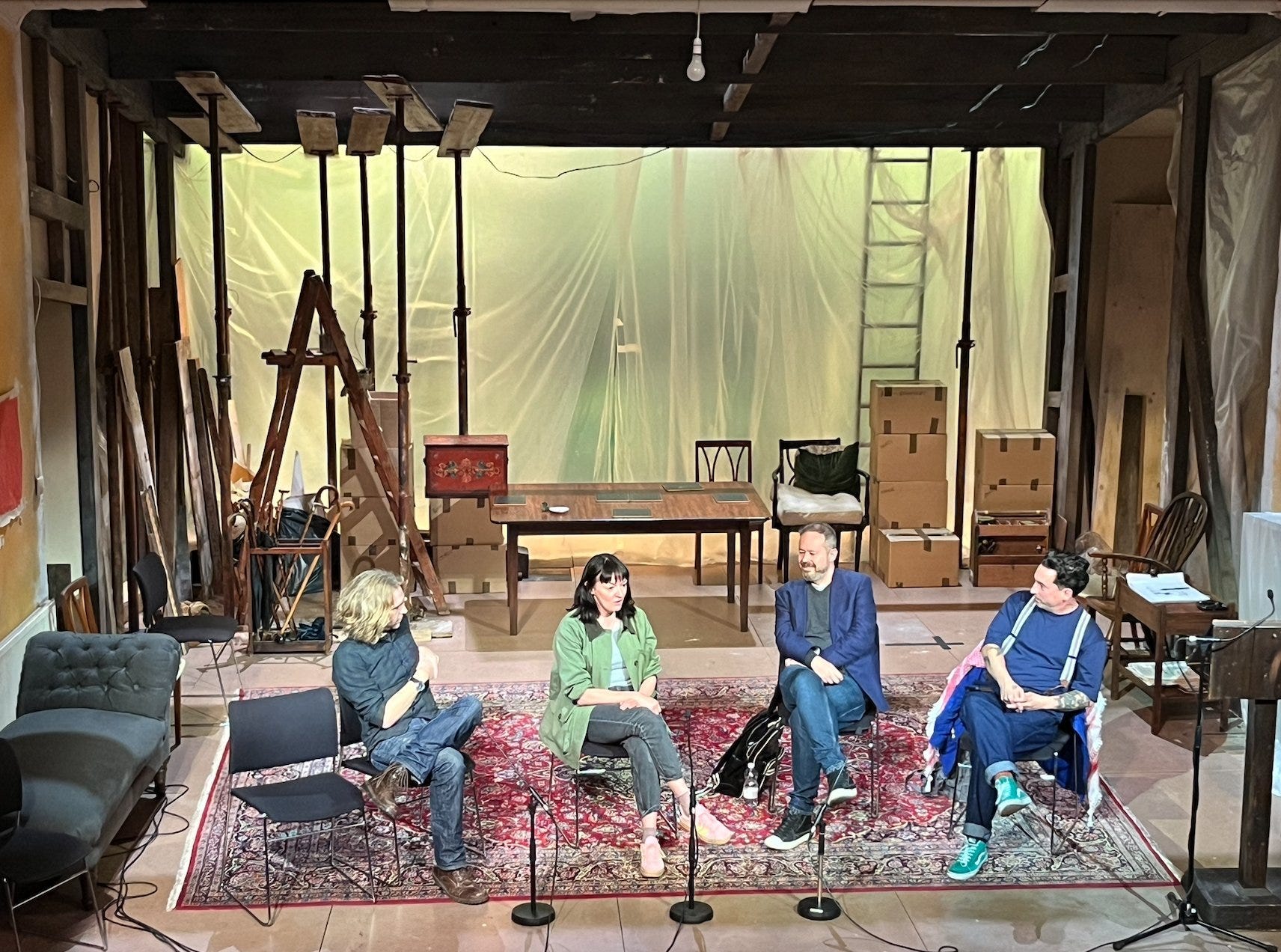
First, I gave a talk the week before last at the Royal Court Theatre in London as part of a day-long conference on Institutional Transformation in the British Theatre. It was a fascinating day with input from people working in the industry alongside academics and I’m told it’ll all be up on YouTube soon. My talk was about how theatres use the diversity data they collect, and what they could and should do with it for antiracist purposes. It’s called ‘After the boxes have been ticked’.
Writing about theatre directing
I wrote a chapter on theatre directors for the Cambridge Companion to British Theatre since 1945 (ed. Jen Harvie and Dan Rebellato) way back in about 2018, but things happened in the world and academic publishers are slow, so it’s only just come out.
The chapter, ‘Directors: Organisation, Authorship, and Social Production’, focuses on three intertwined traditions of theatre directing in Britain in the post-war period. First, I explore the managerial and administrative position of the Artistic Director (key examples discussed are Michael Buffong and Paulette Randall at Talawa, Stephen Daldry at the Royal Court, and Peter Hall at the RSC and NT. Secondly, I analyse the work of ‘auteur’ directors whose focus is primarily on the creation of theatrical ‘performance texts’ (Joan Littlewood, Simon McBurney, Katie Mitchell, Emma Rice are my examples here). Finally, the essay considers three directors (Geraldine Connor, Jenny Sealey and Lois Weaver) whose artistry is to be found, I argue, in ‘social production’: the shaping of relations between people in public space. If you want a quick example of what I mean by that, have a look at this trailer for a film about Geraldine Connor’s Carnival Messiah.
First created as a student production at Wakefield Theatre Royal in 1994 and re-staged in Leeds (1999, 2002, 2007) and Trinidad (2003, 2004), Connor described the Messiah as ‘a spectacular musical showcase, featuring a multi-ethnic multitude of singers, musicians, masqueraders, dancers and actors’. At a time when multiculturalism was under attack from both sides of the political spectrum, Connor created a performance that celebrated (and made implicitly paradigmatic) her own formation at the intersection of ‘a western European culture and a West Indian culture’ (a Caribbean ‘recipient of Handel’s Messiah’) by mixing ‘the genre of carnival and the genre of oratorio’. Connor’s approach rejected the dominant model of intercultural performance famously represented by Peter Brook’s 1985 Mahabharata, which Rustom Bharucha termed a ‘blatant […] appropriation of non-western material within an orientalist framework of thought and action’, being structured instead as a site for ‘bringing people together of all nations and races’ and thereby celebrating the multiple, interwoven strands of post-colonial British culture. […] Connor used this production to emphasise the social process of making, blending professional performers with community choruses, whose cultural heritages shaped its various iterations. In their different ways, therefore, all three of these artists [Connor, Sealey and Weaver] used the work of directing to generate new reciprocities among theatre’s makers and between them and its audiences, and demonstrated the radical potential of performance to function primarily as an exemplary site of social production, rather than artistic consumption.
In all, the chapter aims to use the figure of the director to expose the material conditions and social relations that have shaped creative practices in the theatre, and thus to analyse the social forces and political interests that have governed the sector and its output since 1945. There’s a link to a free pdf on the writing page of my website.
Researching institutional racism in theatre producing
Earlier this year, I was also the lead author of the report Producing Producers: Enhancing Career Development and Training Opportunities for British Theatre Producers from the Global Majority alongside Rafia Hussain (Independent Producer), Jessica Bowles (Principal Lecturer in Creative Producing, Royal Central School of Speech and Drama), and Helen Jeffreys (Executive Director and Joint CEO, Tara Theatre). Our report makes recommendations for improving training and career development opportunities for racially minoritised theatre producers based on a survey of 187 producers, follow-up interviews and a focus group of 25 producers from 23 theatre companies.
One striking finding of the research is that racially minoritised producers were 33% more likely to work as show producers than the average respondent, 50% more likely to be Artist Development Producers and 72% more likely to work in Participation. If you don’t work in the theatre, all you really need to know about these roles is that their status, the budgets they manage and the scale of their work decreases in the order I have given them here, and the likelihood that they will work with racially minoritised people will usually increase in the same order. We also found that producers of colour were 68% less likely to have an executive role. To summarise: we could plot a fairly straight line on a graph showing that as the status of a theatre producer’s role decreases, the likelihood that it will be occupied by a racially minoritised person goes up. There are some quite clear structural explanations for this, none of which seem to be on the radar of the most powerful theatre companies or their major funders. We’re working on further projects to address this.
we could plot a fairly straight line on a graph showing that as the status of a theatre producer’s role decreases, the likelihood that it will be occupied by a racially minoritised person goes up